Why Your Seams Don’t Seem Sew Good
This is part two of the anatomy lesson from the last post! A classic mistake we see on a regular basis with pleated sunburst accordion skirts has to do with the side seams and the center back zipper.
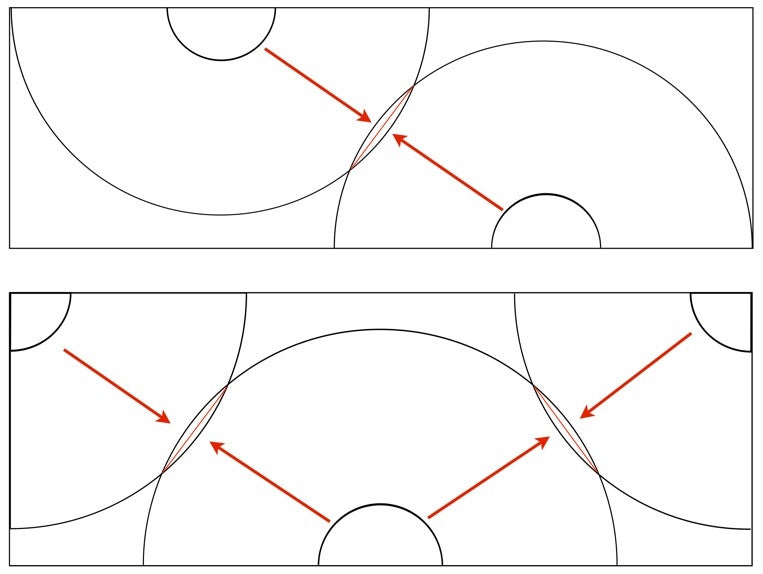
If you read my previous post titled Bias Skirts 101, you understand there are two ways to cut a full circle bias skirt. One way is to cut two half circles, one for the front and one for the back. Doing it this way would leave no margin for error since you can only put a zipper on the side seam and the grain lines will match up.
Below: A picture of two half semi circles. I placed the zipper in between to show its placement at the side seam.

The second option opens up a Pandora’s Box of problems…resulting in ripping and restitching over and over again. A back zipper is usually required with dresses or gowns. That means you will be cutting one half circle and two quarter circles. This way the two quarter circles can be used for the back and a zipper can be sewn in the center.
Below: A picture of one semi-circle panel for the front and two quarter panels for the back.

Now here is where the problem begins. It is most common for people to sew the center back along the selvage edge of the fabric. This is the logical thing to do when you are cutting a garment on the grain. However, when cutting a bias garment or a circle skirt you need to account for all three grain lines.
Below: A picture of the selvedge placed at the center back seam.

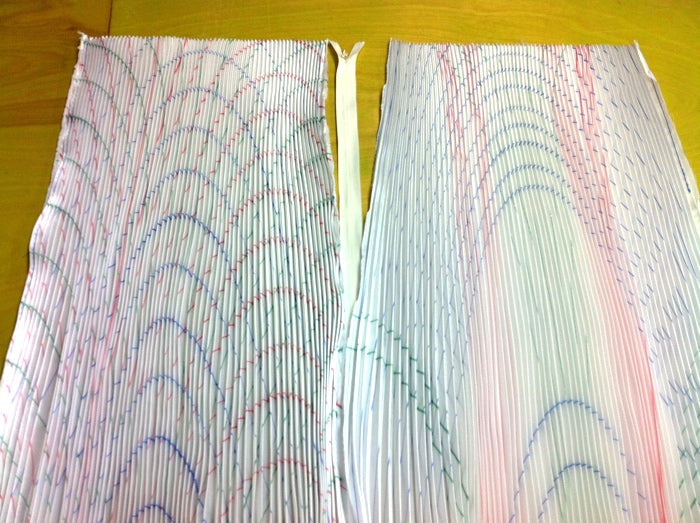
So… if you sew a skirt with the selvedge edge along the center back (as shown above), the grain lines at the side seams will be perpendicular. Look at the BLUE lines below.
Below: Perpendicular straight grain.

To have the correct placement of grain lines at the side seams, make absolutely sure the selvedge edge runs along the sides and the cross grain runs up/down along the the center back.
Below: Notice the BLUE grain line runs in the same direction, as well as the GREEN cross grain.

Below: Close up of proper grain line placement at side seams.

The amount of frustration you will experience when you sew your garment can vary greatly depending on the type of fabric you use. Fabrics react differently depending on the situation so there is no fixed list of fabrics. Generally, stiffer fabrics like taffeta are less problematic than delicate silks. Fabrics that stretch more on the cross grain than straight grain are prime candidates. However, now that you have this information don’t take any chances. Follow the grain whenever you can and you will probably avoid countless hours of swearing at your sewing machine.  If you have sewn a pleated skirt in the past and just realized this was your mistake, don’t feel badly. When it comes to pleating, many people are unaware of these techniques.